Fire Season Ready - Seven Things Every Aussie Home Needs This Summer
As everyone unfortunately knows, Summer in Australia is fire season. We can't control…


As everyone unfortunately knows, Summer in Australia is fire season. We can't control…
While most people's minds go to equipment for protecting against bushfires when they…
It’s always best to leave your home early if faced with an oncoming fire front, but…
When a turbine pump plays up, it needs a suitable replacement quickly. That's why…
When a local winery experienced pump failure, the team from Webster Water Solutions…
Propagation house irrigation requires precise water management and integrated systems.…
Discover how Albany Irrigation & Drilling helped their customer understand what's…
Firefighting pumps are usually chosen on the two biggest numbers on the label, maximum…
Whether you're carrying out hazard reduction burns, managing vegetation, maintaining…
Did you know? The WBS Pumps firefighting pump is built for more than just emergencies.
With bushfire risk an ongoing concern for rural and regional properties, having a…
When bushfire or grassfire threatens, your pump is the one piece of equipment you…

Firefighting pumps are usually chosen on the two biggest numbers on the label, maximum head and maximum flow rate. A centrifugal pump can't produce both at once. Maximum head is the pressure the pump makes with the outlet shut and no water moving. Maximum flow rate is what it delivers discharging freely at ground level against no back pressure. The pump operates somewhere between those two points, and where it lands is determined by the system you connect it to.
Elevation costs one metre of head for every metre of lift. Rooftop fire sprinklers on a two-storey house are elevated ~9m.
Friction in the hose costs more than most people allow for. It rises with the length of the run and falls sharply with hose diameter, so 50m of 25mm hose will cost you considerably more head than 50m of 38mm at the same flow. Use the largest diameter you can and keep the run as short as the layout allows.
Nozzle pressure is what produces the stream. Most fire hose nozzles are designed to operate between 350 and 700kPa, which is 35m to 70m of head. Below that range the throw and the spray pattern both fall away.
Those three added together give the head the pump must produce, at the flow rate you want to run.
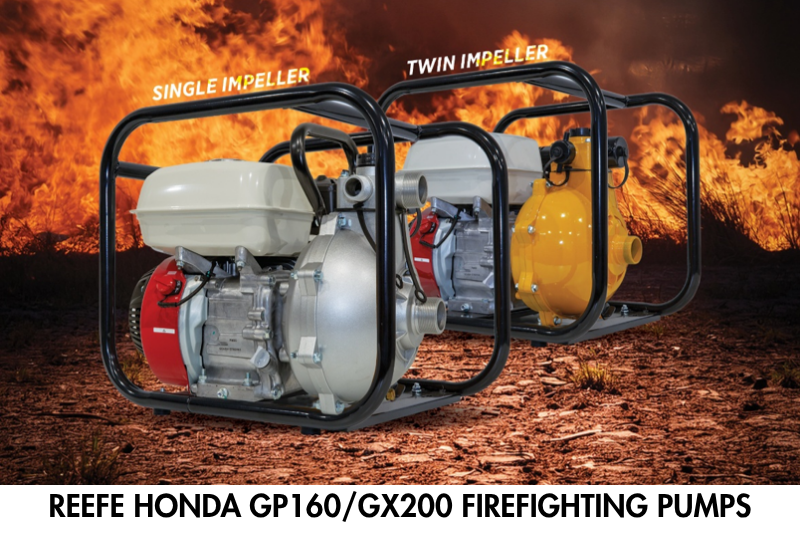
A single impeller pump delivers more flow at lower pressure. It suits filling tanks and slip on units, wash down, boom spraying, and fighting fire close to the water source on short hose runs.
A twin impeller pump passes water through two stages, which produces substantially more pressure at a lower flow. It suits elevation, long hose lines, rooftop and perimeter sprinkler systems, and any duty where the stream has to reach.
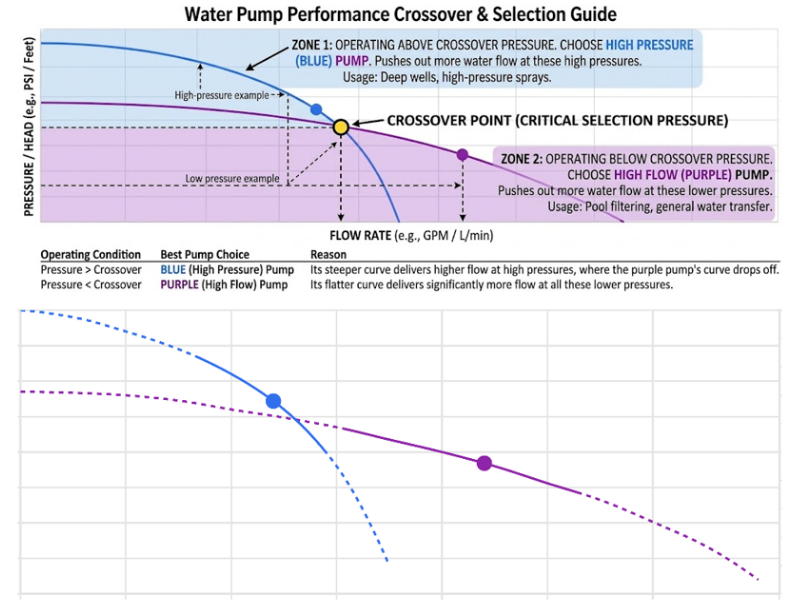
The two curves cross. Above the crossover flow the twin impeller produces more head, below it the single impeller delivers more water. Working out which side your duty falls on is the point of the exercise.
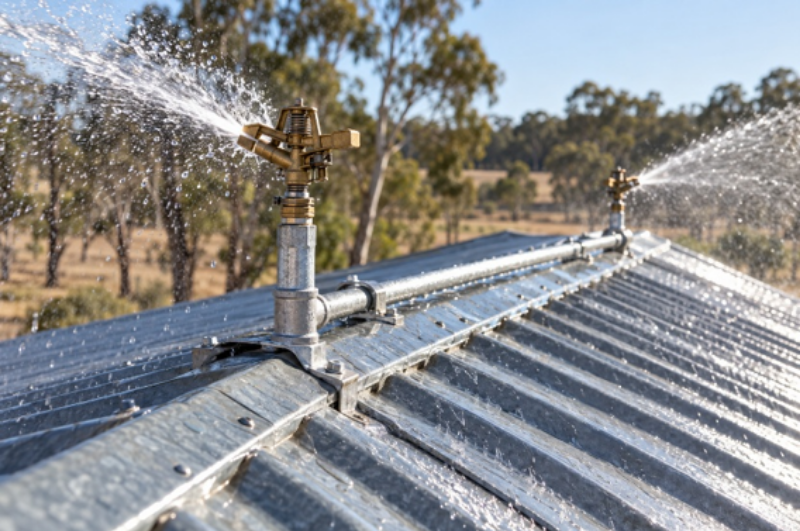
Worked ExampleRooftop sprinklers on a two-storey house, 50m of hose from the tank, sprinklers requiring 400kPa. Elevation is 9m, sprinkler pressure is 41m, and friction through 50m of hose at the working flow is roughly 12m. Total required head is around 62m, and it has to be available at the working flow rate rather than at shutoff. |
 |
A single impeller pump with 52m maximum head cannot reach 62m at any flow. A twin impeller rated to 68m maximum is producing well below that figure once it's moving useful water, so it won't reach it either. The duty requires a RPP high-pressure twin impeller unit with 92m Head.
The opposite situation would be filling a 10,000L slip on tank from a dam, where the required head is low and the priority is volume. A single impeller pump will fill it considerably faster than the high-pressure unit.
The REEFE range self-primes to 6m with a foot valve fitted, and flow falls as suction lift increases.
| Suction lift | GP/RP single impeller | RPP single impeller |
| 0m flooded | 380 L/min | 377 L/min |
| -1.5m | 361 L/min | 354 L/min |
| -3m | 342 L/min | 320 L/min |
| -4.5m | 311 L/min | 274 L/min |
| -6m | 266 L/min | 227 L/min |
At 6m of lift the GP/RP single impeller is down 30% and the RPP single impeller is down 40%. Positioning the pump lower and closer to the water will recover that flow.
Fit the foot valve. Without one the pump loses prime between starts and has to be primed by hand before each use.
We stock four series, all Honda powered.
| Series | Impeller | Max head | Max flow | Suction | Wet end warranty |
| GP & RP Single | Single | 52m | 400 L/min | 1.5" | 2 years |
| RPP Single | Single | 70m | 380 L/min | 2" | 3 years |
| GP & RP Twin | Twin | 68m | 257 L/min | 1.5" | 2 years |
| RPP Twin | Twin | 92m | 280 L/min | 2" | 3 years |
The RPP series runs a 2" suction inlet against 1.5" on the GP and RP series. The RPP single impeller makes 70m maximum head against 52m, and the RPP twin makes 92m against 68m while also delivering 280 L/min against 257 L/min. The RPP wet end warranty is 3 years rather than 2.
Engine choice affects the engine warranty. The GP160 carries Honda's 1 year universal warranty. The GX160 and GX200 carry 3 years.
Electric start models are supplied without a battery or leads. They require a 12 V battery rated at 18Ah or higher, kept charged through the season. Recoil start models have no battery to maintain.
Every model is available with or without a roll frame. The frame adds 4kg and protects the engine and wet end during transport and storage.
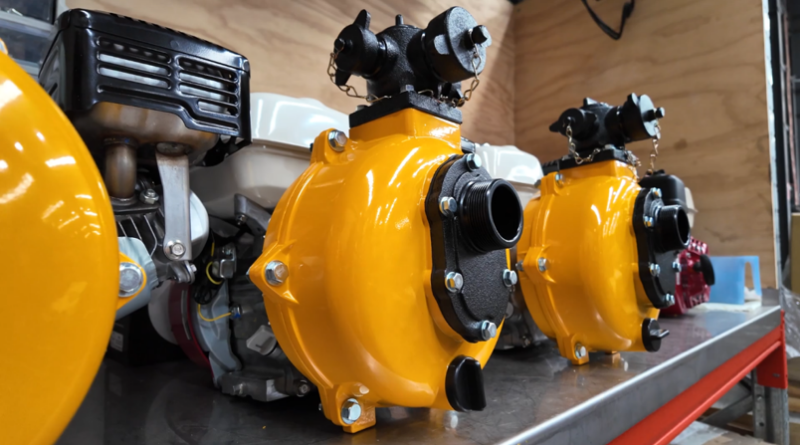
All four series use an alloy closed vane impeller with heavy duty cast inlets and outlets, and all have one 1.5" and two 1" discharge outlets, so multiple lines can be Run From One Pump.
Water supply and access requirements in bushfire prone areas vary between states and councils. Your local fire service is the authority on what your property requires.
A firefighting pump is for property protection. It does not change the advice about whether to stay or leave, and that decision should follow your fire plan and the direction of your local fire service.
Pump selection depends on your water source, hose diameter and run length, elevation, and what you need the water doing at the far end. Those figures take a few minutes to work through, and it's worth doing before the season starts.
Bring us the layout and we'll calculate the head and flow required and match a pump to it.
Your local Irrigear store stocks the REEFE firefighting range and can order any model in the series.
Find an Irrigear® store near you

Irrigear® Independent Experts.
We're the largest network of independently owned water specialist retailers in the country – with owner-operated locations across Australia.
GEARED FOR BETTER IRRIGATION®
Advice. Products. Solutions. Australia-wide.
At your local Irrigear store you'll find expertise and access to Australia's leading brands and products in all areas of water and fluid management.
Irrigear is proudly a member of Irrigation Australia (IAL) and the Australian Retailers Association (ARA).


Level 1, 28 Milgate Drive
Mornington, Victoria Australia 3931
1800 477 443
03 5976 1588